Read from the source
Agent calls, tokens and cost from your AI bills, status changes in Jira and events in GitHub. Timestamps give elapsed time, not hours worked.
Nothing to install on laptops, nothing in the path of your agents, nothing written back to your systems.
Connect Jira, GitHub and your AI bills with read-only scopes. AVYV joins them by time window and author and shows team-level cost per finished unit, labeled inferred.
Engineers add one correlation ID to agent calls. Each agent attempt and its cost then join the work item it advanced, and the AI cost moves from inferred to observed. Review and rework keep the label for how they were measured. Nothing is added to Jira.
Each task class passes or fails the automation gate, against criteria your CFO signed on day one. You keep the numbers either way.
The correlation ID ties each agent attempt and its cost to a work item. It can't see people's time, so that is sampled, and the label says so.
Agent calls, tokens and cost from your AI bills, status changes in Jira and events in GitHub. Timestamps give elapsed time, not hours worked.
Review and rework hours come from a time study on a sample of work items, applied to the task class with its range.
AI cost tied to a work item by time window and author where no correlation ID links them. It stays labeled inferred until one does.
Loaded rates per role. Your Finance team sets them, and AVYV doesn't measure them.
The figure on the board slide and the rows behind it come from the same query. If a figure can't be opened to its records, AVYV doesn't show it.
Cost of finished work, as a manager sees it.
The one change at day 30. AVYV reads the ID from billing metadata. It never sees the prompt or the response.
Request header on each agent callX-Work-Item: PROJ-1184Work-Item: PROJ-1184| Source | Record | Value | Label |
|---|---|---|---|
| Jira | In Progress → In Review | 10:02 | observed |
| Jira | In Review → Done | 15:27 | observed |
| GitHub | Review hours on the linked pull request, from the time study | 2.5 hr | sampled |
| AI billing | 3 calls and 5,520 tokens | $0.28 | observed · inferred |
| Finance | Loaded rate for the engineering role | $80/hr | declared |
Illustrative work item. Every input carries its label and source: observed, sampled, inferred or declared.
What a team sees for one workflow: the agent cost of each finished item, and where the time goes between start and done.
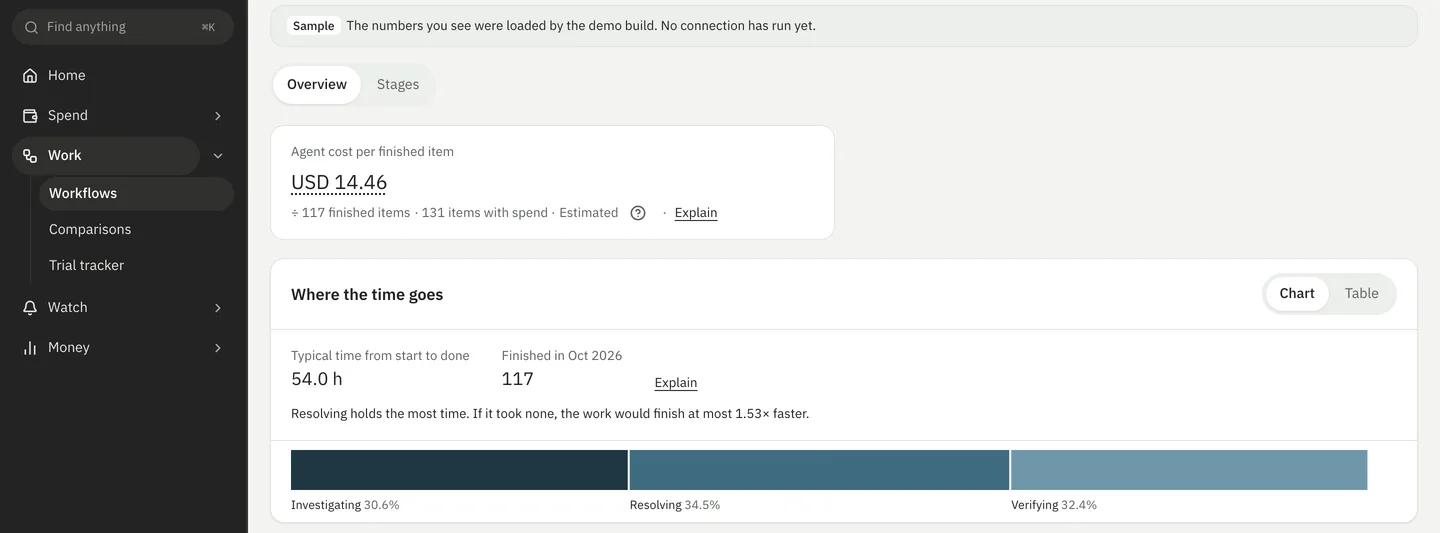
Conceptual product preview. Sample data from a demo build, not customer data. Screens may still change.
AI runs, human review, rework and failed attempts, per task type. The unit is work the business bought, not tokens or seats.
Volume, first-pass yield and reviewer capacity drive the forecast. You see the cost before you commit, and which team runs out of room first.
Automate a task type when the share that passes first time beats the agent's cost plus the cost of checking it: q > α + ρ. The answer comes from your own records, on numbers Finance accepts.
q = first-pass yield · α = agent attempt cost as a share of human production cost · ρ = verification cost as a share of production costHow the gate works →Bring one workflow. In 30 minutes we'll show what your records can prove today, and label what is still an estimate.
Read-only. Metadata only, never prompts or code. 60-day proof of value, and you can walk away at no cost.